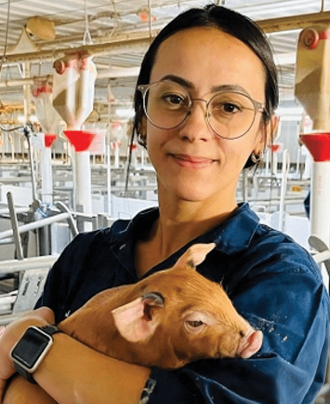
ABOVE: Researcher Cintia Amaral.
AUSTRALASIAN Pork Research Institute Limited PhD Top-Up Scholarship recipient Cintia Amaral is making the most of every opportunity her PhD has to offer. Keen to expand her knowledge, build industry connections and gain hands-on experience, Cintia recently embarked on an international research journey across the US and Denmark. Along the way, she worked with leading researchers, explored cutting-edge technologies and gained valuable insights into global meat and pork production systems. Below Cintia shares how these experiences have shaped her research and strengthened her passion for a career in the pork industry.
I believe it is important to take every opportunity to learn during a PhD, as these experiences are valuable in preparing for the next stage of a career after graduation. With that in mind, I began exploring opportunities abroad that could expand my knowledge and give me international research experience.
As the US is one of the world’s largest producers and exporters of meat, I contacted a potential host supervisor at Colorado State University, which is well known for its work in meat science. This led to an opportunity to spend four months as a visiting scholar, collaborating on ongoing research projects within the meat science group.
During this period, I also collaborated on a project with the University of Wyoming and participated in a joint trial involving Texas Tech University and Texas A&M University. I attended courses, industry workshops, lectures and the Reciprocal Meat Conference, where I presented a poster on my PhD research. Before returning to Australia, I visited Kansas State University, Iowa State University, Purdue University and the University of Minnesota to learn more about their research in animal and meat science.
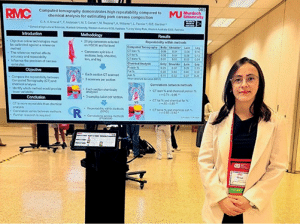
Cintia attended courses, industry workshops, lectures and the Reciprocal Meat Conference, where she presented a poster on her PhD research.
Following my experience in the US, I spent one week in Denmark on a technical visit with Frontmatec. This company manufactures AutoFom III, an objective online technology used to predict pork carcass composition in abattoirs. During the visit, I gained a better understanding of computed tomography calibration procedures, image analysis and the development of prediction models to calibrate AutoFom III.
The program also included a visit to the Danish Meat Research Centre, where I learned about the national trials conducted to validate and approve carcass classification technologies and their calibration procedures. I also visited a commercial pork abattoir, where I had the opportunity to see AutoFom III operating under commercial conditions. As part of this visit, I attended a meeting with the production management team to learn how carcass composition and predicted cut yields can support cut-floor optimisation, production forecasting, processing efficiency and maximising carcass value.
One common aspect I observed in both countries was the strong collaboration between universities, research centres and industry in supporting research, innovation and technology development to address real industry needs. I also noticed a willingness to openly share information about ongoing projects, which supports knowledge exchange across the sector.
Another interesting aspect I observed in the US was the opportunity for students to work closely with industry, supporting the management and analysis of non-sensitive data generated through the company’s internal operations and processes. This gives students practical industry experience and strengthens collaboration between universities and industry.
This time abroad allowed me to learn about different aspects of the meat supply chain, from animal production to processing. These experiences exposed me to different research groups, facilities and approaches, enhancing my understanding of how research is conducted and applied in practice. I also gained practical insights into how carcass assessment technologies can be translated into commercially relevant decisions within pork processing systems.
This is particularly relevant to my PhD research, which focuses on evaluating alternative reference methods for calibrating technologies used to predict pork carcass composition and commercial cut weights within the Australian pork industry. The knowledge gained from these international experiences will directly contribute to my PhD research and support the final stages of my thesis. Additionally, the skills developed and professional connections established during this time will be valuable for my future career within the pork industry.
Well done to Cintia for getting out there and experiencing the broader industry. Her enthusiasm for learning and willingness to seek out new opportunities are inspiring, and it’s great to see her bringing valuable knowledge and connections back to the Australian pork industry. We wish Cintia all the best with the remainder of her PhD and look forward to seeing where her research and career take her next.
Cintia’s research trip was in part supported by APRIL and Murdoch University.
APRIL