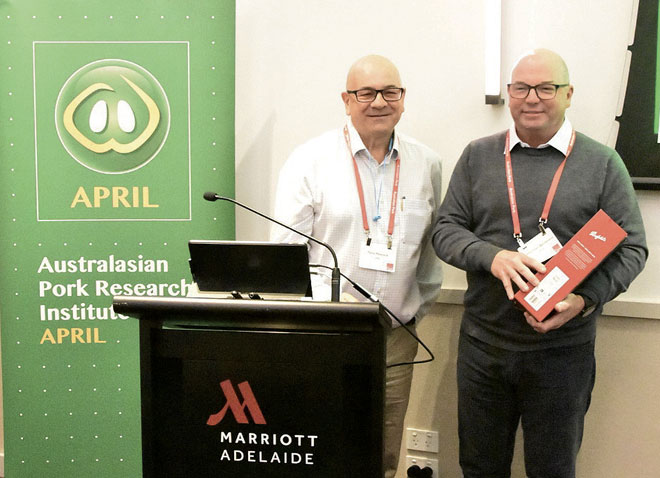
ABOVE: APRIL chair Dr Tony Peacock thanking Professor Robert van Barneveld for his outstanding contribution to APRIL following his retirement from the Board.
Focused on the future at Stakeholders Day
WHAT does the future hold for Australian pig science? This was a key question at the Australasian Pork Research Institute Limited 2026 Annual AGM and Stakeholders Day, where 80 representatives across APRIL member organisations took time to discuss research and reflect on the past year of funding opportunities. The event, held at the Marriott Hotel in South Australia, explored not only the types of research most needed by the pork industry, but also the importance of attracting, developing and retaining high-quality researchers to strengthen current capabilities.
Alongside the research discussions, the event marked an important change to the APRIL Board with Professor Robert van Barneveld officially stepping down after serving as a Board member since APRIL’s establishment. Prof van Barneveld has played an instrumental role in shaping APRIL and contributing to its success. From authoring the original APRIL prospectus to chairing the Audit and Risk Committee, he has provided invaluable commercialisation expertise, industry experience and leadership. His contribution has helped shape APRIL into the organisation it is today, and the occasion provided an opportunity to acknowledge and celebrate his outstanding service.
While Prof van Barneveld will be greatly missed, APRIL is pleased to welcome Dr Kate Plush from SunPork Group and Mark McLean, an Australian Pork Limited Board member, to the Board. Their extensive industry knowledge and experience will be valuable in guiding APRIL’s funding decisions and supporting research projects that deliver meaningful outcomes for the industry.
Following the recent restructuring, APRIL also introduced its new 2026-2029 Strategic Plan, which will guide the organisation’s research, development and education priorities over the next three years. A key priority in the plan is to support larger-scale research projects that address significant challenges or opportunities for the industry. These projects, referred to as ‘transformational projects’, involve greater collaboration with multiple external partners and are designed to leverage APRIL funding to achieve broader outcomes. They will also create opportunities for APRIL to support initiatives through programs such as CRC-P and ARC Linkage grants.
The strategic plan also highlights the importance of strengthening industry partnerships, expanding education and training opportunities, retaining existing participants and continuing to grow APRIL’s membership and funding base. In a positive development, we welcome the Craig Mostyn Group as APRIL’s newest gold member participant and look forward to CMG’s contribution to our education, training and research and development programs.
The industry’s chief scientist Dr John Pluske provided an overview of Australia’s current research landscape, highlighting the importance of attracting and retaining high-quality researchers. His presentation raised concerns about the growing limitations in research facilities, resources and specialist expertise across Australian universities and government agencies. A national survey estimated that pork industry research and development personnel had declined by approximately 20 percent between 2008 and 2025, reinforcing the need to invest in and support both current and emerging researchers.
The recent establishment of the Australian Pork Industry Education and Training Committee is an important step towards addressing these challenges. The committee will help strengthen the industry’s future capability by fostering research and opportunities in education and training. Alongside broader industry discussions, the stakeholders day was a chance to hear updates on the progress and outcomes of ongoing research projects, as well as newly funded initiatives.
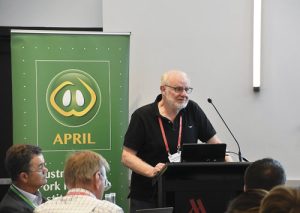
Professor Frank Dunshea explains the ‘check-all-that-apply’ method and its application in the sensory evaluation of pork.
Professor Frank Dunshea from the University of Melbourne presented research into more objective approaches to assessing meat quality for scientific research. Drawing on findings from projects 5A-108 and 5A-120, Prof Dunshea highlighted the ‘check-all-that-apply’ method as a faster alternative for assessing consumer perceptions of food product sensory characteristics. Using this approach, Project 5A-108 identified potential genetic variation associated with intramuscular fat and collagen content. Additionally, findings from project 5A-120 indicated that dietary lecithin supplementation may improve pork flavour, highlighting further opportunities to enhance pork quality through nutritional interventions.
Pig health was another important focus, with Associate Professor Farhid Hemmatzadeh from the University of Adelaide presenting his team’s ongoing research into development of a more effective vaccine for porcine respiratory disease. The novel vaccine is designed to provide a closer antigenic match to the Australian m hyopneumoniae strains and importantly, does not require porcine serum during its manufacture. This research has considerable potential for commercial application and APRIL looks forward to following its continued development.
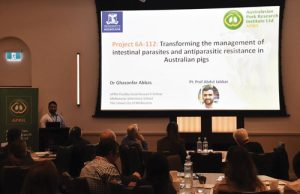
Dr Ghazanfar Abbas presenting his proposed research on scoping the current state and impact of intestinal parasites management in Australian pigs. Producers are encouraged to participate in this research by scanning the QR code provided.
The health theme continued with APRIL’s recently appointed Postdoctoral Fellow Dr Ghazanfar Abbas from the University of Melbourne outlining his proposed research into intestinal parasite management in Australian pigs. The research aims to establish a clearer understanding of the prevalence and impact of intestinal parasites, their long-term effects on pig health and productivity and the emerging challenge of antiparasitic resistance.
Australian pig producers are encouraged to contribute to this important research by completing a national questionnaire. The survey is open to all producers, regardless of farm size, production system or whether internal parasites have been identified on farm. Producers who are interested in receiving a free faecal analysis of their pigs can also choose to provide their contact details at the end of the survey. Click here for further information.
APRIL sincerely thanks all presenters and attendees who contributed to the stakeholders day. It was particularly encouraging to see the strong representation of students and emerging researchers sharing their work during the education and training session.
Presentations showcased a diverse range of research from PhD candidates, with Sarah James from Adelaide University presenting her ongoing research into monitoring reproductive states in sows, Ashiqur Rahman from Murdoch University whose research aims to protect pigs from ceftiofur-resistant e coli, Chandra Chouhan from Murdoch University outlining the development of an oral fluid-based disease diagnostic and Wendy Izedonmwen from the University of Queensland sharing her research into Australian canola and soybean in pig diets.
The education and training session also provided the opportunity to hear from APRIL’s emerging research professionals, with Postdoctoral Fellow Dr Bryony Tucker from the South Australian Research and Development Institute reflecting on her fellowship journey, while Dr Katelyn Tomas from JBS Pork Australia shared her experience following her recent participation in the APRIL Industry Placement Program. The quality and diversity of these presentations shows value of investing in emerging talent and providing opportunities for the next generation of researchers to contribute to the future of Australian pig science.
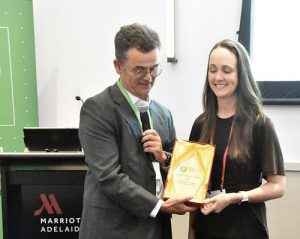
Dr Tanya Nowland accepting the APRIL Enterprise Award on behalf of herself and Dr Lissa Kautto for their innovative approach to reproductive state detection in swine.
Finally, congratulations also goes to Dr Tanya Nowland and Dr Lissa Kautto – recipients of the APRIL Enterprise Award – for their innovative concept of a novel detection method for reproductive states in swine. The technology has been tested and validated through pig trials and collection method is non-invasive, offering a practical and commercially viable solution for the pork industry.
We congratulate Tanya and Lissa on this exciting achievement and look forward to seeing the technology progress towards commercial application. Again, we thank all those involved with the APRIL stakeholders’ day and look forward to the future with the new 2027-2029 strategic plan.
For more information about the day or any APRIL matters, contact APRIL executive officer Dr Charles Rikard-Bell at c.rikardbell@april.org.au
APRIL